



🚀 New Feature Alert : Introducing RDash Activity Schedule! Plan, Track and Collaborate.  Check Now

Rdash
firstbit

RDash vs Firstbit

Comprehensive Features Comparison

 Detailed insight into how RDash and Fristbit stack up against each other in pricing and features.

Rdash logo

What is RDash?

Rdash is a simple and easily adoptable software that brings rhythm across design, projects, finance, and procurement. It keeps the BOQ (Project Scope) at the center and ties progress, cashflows, margins, and quality control down to the item level. Also, Rdash is extensible to your clients and vendors to bring an all around rhythm on your project.

Built for fast adoption, Rdash is best fit for small and medium scale proejcts because it is simple enough for site teams and deep enough for CXO. for larger jobs, use Rdash as the digital backbone alongside specialized tools.

Why teams choose Rdash:
→ Best fit for small and medium scale construction projects
→ Adequate depth on both fronts i.e. progress tracking and financial management
→ Shortest cycle time, 90-day deployment guarantee
→ Dedicated Account Manager + On-Premise deployment support

*Pricing: RDash is priced on a per-user license model, so you scale seats as your team scale.

firstbit

What is Firstbit?

FirstBit is a construction-focused ERP platform designed primarily for contractors in the UAE and Middle East. It combines project execution with finance, HR, payroll, procurement, and compliance into a single system. FirstBit works well for organizations that want an all-in-one ERP backbone. However, for teams that are execution-heavy and manage multiple fast-moving projects, the platform can feel rigid and ERP-first, requiring significant setup, configuration, and training compared to RDash’s BOQ-driven, project-centric approach.

Salient features:
→ Strong ERP-led construction workflows covering finance, HR, payroll, and compliance
→ Designed for mid-to-large contracting firms with structured processes
→ Setup and customization effort is high, making adoption slower on live projects
→ Less intuitive for day-to-day site execution and collaboration compared to RDash
→ Support and implementation ecosystem is largely Middle East–centric

*Pricing: FirstBit is typically priced as an ERP implementation, involving license costs plus implementation, customization, and annual support fees

RDash Pricing Plans

RDash Pricing Plans

Firstbit vs RDash: Feature wise comparison

Category & Features

Rdash
firstbit

Pre-sales / CRM

Rdash helps you smoothen the hand-off from sales to projects by bringing the project knowledge such as Design Iterations, Scope Changes, Quotations etc. together before you have won the project.

FirstBit is largely a post-award, ERP-driven system focused on financial control and compliance; it has limited collaboration capabilities, a manager- and accounts-led UI/UX, and comparatively less intuitive, form-heavy interfaces for site teams, resulting in weaker continuity of pre-sales knowledge, design iterations, and scope evolution from sales to on-site execution.

Lead capture & funnels

Built-in lead funnels; capture/import leads.

Offers basic lead or enquiry tracking via CRM-style modules, but lead funnels are not a core, execution-linked workflow.

Marketing integration

Integrates with ads/website for lead intake.

Does not natively integrate with ads or website lead sources and typically depends on third-party tools or manual imports.

Quotations & proposals

Quick quotations & proposals; convert to project.

Supports quotation creation from a commercial perspective, but quotations are loosely connected to design, scope, and technical collaboration.

Convert lead to project

Convert lead into a project with all the information developed till date with a single click.

Converts quotations into projects through structured ERP processes, with limited carryover of pre-sales context and collaboration history.

Site Survey / Recce

Rdash offers Smart recce & technical survey through Mobile App. You can configure survey templates based on project types which guides the site surveyor to complete the comprehensive survey in one visit.

Does not offer a dedicated smart site recce or technical survey module comparable to RDash.

Survey Templates Configurations

Configure site survey templates from the frontend without needing a software developer support from Rdash

Export survey report

Export surevey report in PPT or PDF

Assign Survey task for field team

Survey Task is assigned on web and conducted via mobile app

Contextual collaboration on survey docs

Go inside survey files i.e. images of PDF and initiate contextual collaboration in plangrid/fieldwire style

Design Management

RDash has a mini plangrid or a fieldwire built inside the design module where you can store design files, control versions, define approval workflows, and conduct digital review with design marking tools which are accessible both on mobile app as well as browser stack. RDash do not support BIM integration yet, it is a part of its roadmap. 

Provides document management and version storage for drawings and files.

Design management / versioning

Design versions & change marks.

Version control is in place, but design review is largely approval-driven rather than collaboration-driven.

Design reviews / pin comments

Pin comments directly on design files (PDFs and Images)

No design marking or pin commenting available

Design Approval Workflows

Set-up a maker-checker workflow on design files

Maker-checker workflows can be configured at a document approval level, not at a granular markup level.

Share design files to vendors

Share specific design files to vendors, they get notified on whatsapp/email whenever there is a new version of the file

Vendor sharing is possible, but notifications are typically sent via email, not WhatsApp-native.

Project Scope Management / BOQ

RDash offers a fine tuned management of project scope (i.e. BOQ – bill of quantities) wherein you can track client confirmation on individual scope items, create BOQs from master catalogue of items, place order agains BOQ items, assign budget guardrails on BOQ elements, and much more.

Strong BOQ and cost head management, aligned with ERP accounting structures. FirstBit excels in financial control of BOQs, but is less fluid in client-facing scope evolution and approval automation.

Client scope creation & sharing

BOQ authoring & sharing; item-level controls.

BOQs are tightly coupled with budgets, cost codes, and financial reporting.

Client Scope Vs Order analytics

Automatically throws P&L against BOQ elements for a handy review.

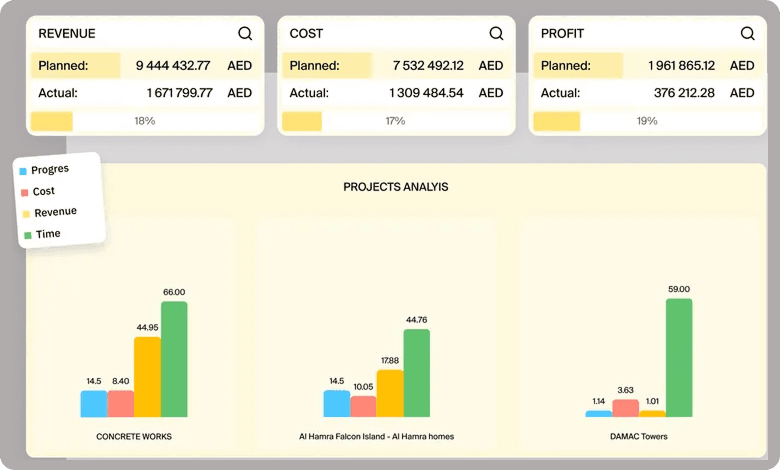
Provides integrated project cost control dashboards that analyze BOQ-based costs and generate real-time project profit & loss visibility across budget, purchases, and expenses using its ERP financial engine

Change order management

Seemlessly track client approval status against BOQ elements. Consolidate all changes in the BOQ and create change order proposal for clients in one click. Client can approve via email without login into the system.

Change orders are supported but typically require manual consolidation and formal workflows.

Budget rates on BOQ

Manage both client rates and budget rates against BOQ elements → take charge of the P&L right at the planning stage

Separate tracking of client rates vs internal budget rates is supported, but not always visualized as real-time P&L per BOQ line.

Client PO/Invoices & Payments

Track client side documentation in tandem with BOQ progression

tracks client invoices, advance payments, retentions and collections within its finance and project modules, linking billing and payment documentation to project budgets and cash-flow reporting.

Orders

‘Order’ is the second most comprehensive module (after work progress) inside RDash to manage ‘all things payables’ inside a project. You can create an order batch linked to BOQ, set approval permission chain, and automate order creation and communication to vendors. Link orders to your ERP for seamless data management. You can manage supplier’s running invoices and final invoices and initiate payment requests. Also, manage imprest expanses of your site executives.
‘Order’ module allows you to share extend Rdash access (as collaborators) to your vendors and helps you automate reconciliation, change order management, and project tracking with your suppliers.

Firstbit has a comprehensive Purchase Order module with automated workflows

Add Vendors/Client as Collaborators

Piggiback orders with design and survey files so that the respective vendors are alerted when the documents concerning to them undergoes a change

Allows limited external access for vendors and clients, primarily for transactional visibility rather than deep, contextual collaboration.

Approval flow on POs, and Invoices

Configure approval workflows based on amount, roles, and custom configurations

Offers robust, configurable approval workflows for POs and invoices based on roles, hierarchies, and financial thresholds.

Rate contracts

Pull order items and rates from the catalogue

Msaintains centralized item masters and vendor rate contracts that can be pulled directly while creating purchase orders.

Automatic PO generation

Configure pdf template and standardise terms and conditions to auto-generate and email POs to vendors.

an auto-generate purchase orders using predefined templates and standard terms, and distribute them to vendors via email.

Petty-cash/Imprest management

Site executive can log ‘out-of-pocket’ expanses for a project, can tag it to a vendor orders to auto-create debit logs

supports petty cash and imprest expense logging with accounting controls, though typically managed through finance-centric workflows rather than field-first mobile UX.

Vendor Descoping and Debits

Modifying orders is seamless, Rdash auto flags the modification in the supplier orders and creates an audit trail

allows order amendments and debit notes with proper audit trails, but changes are managed through formal ERP workflows rather than live collaborative reconciliation.

Payment Terms Standardisation

Standardise payment terms which can be easility pulled on a project with a drop down

Enables the standard payment terms to be defined at vendor or project level and reused consistently across purchase orders.

Vendor wise DPRs

Track vendor stated progress inside a project 

Can track vendor-linked progress and billing data, but does not natively generate real-time, vendor-submitted DPRs within the order context.

Reverse Bidding/ RFQ

Part of Rdash Roadmap. The Reverse bidding will be shipped AI native which will allow you take quotation from the Rdash ecosystem of GCs and SCs as well.

Installed Progress Tracking

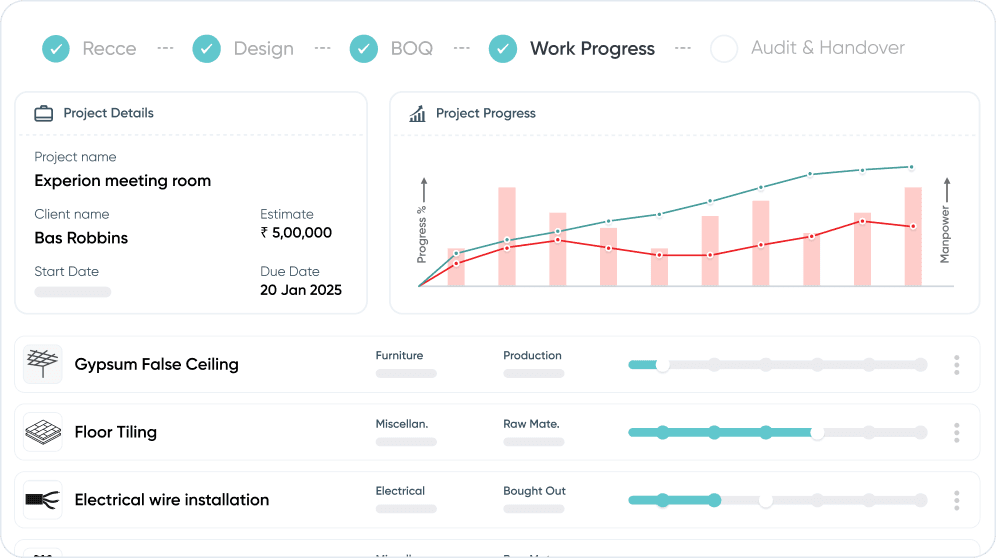
RDash helps you establish a mechanism to capture installed % on the client scope (BOQ) at weekly or monthly frequency to be on top of their invoicing, collection, and monthly P&L. You can Configure item types and the progress tracking milestones to different item types. E.g. Production items such as furniture can be tracked in milestones such a Material Procured → Structuring Done → Ready for dispatch → Installed a site etc. while the site updates such a progress on ‘Raft foundation’ can be tracked in exact quantities or percentages. Rdash helps you track the real installed value of work against your client invoicing & cashflows, helping you control your exposure risk on a project.

Progress tracking is generally cost-centric or quantity-centric, aligned with billing cycles. Supports WIP, RA bills, and revenue recognition.

Item type linked tracking milestones

Site supervisor has an intuitive mobile interface to log the installed progress

Mobile progress updates exist but are form-driven, not milestone-guided by item type.

Safeguards against mis-reporting

Intuitive safeguards built out-of-box that aligns the site supervisors to report the correct progress without fudging the numbers

Installed Revenue Vs Invoicing Vs Collection

Out-of-box management dashboards that allows you to be on top of your cashflows in a project

Less emphasis on installed value vs invoiced value exposure analysis. Dashboards are financially strong, operationally less intuitive for site teams.

Activity Tracking – Site Schedules

RDash offers a fine tuned management of project scope (i.e. BOQ – bill of quantities) wherein you can track client confirmation on individual scope items, create BOQs from master catalogue of items, place order agains BOQ items, assing budget guardrails on BOQ elements, and much more.

FirstBit offers an in-built scheduling system to plan project timelines and track costs against the schedule.

Planned vs Actual work timelines

Track how far behind or ahead you are on your planned schedule

Can manage the entire timeline of the project

Multilevel Activity grouping

Nesting of activities like the way it is in MSP or P6

Can create multiple dependencies like MSP/P6

Link dependencies

Manage all four types of dependencies to arrive on a critical path

Can link all types of dependencies

Easy Mobile accessebility from site

Site supervisors find it much easier to update from mobile

Schedule updates are manager-driven, not site-driven.

Import Excel & MSP

Seamlessly Import MSP file to Rdash and Rdash file to MSP

Materials

RDash offers a fine tuned management of project scope (i.e. BOQ – bill of quantities) wherein you can track client confirmation on individual scope items, create BOQs from master catalogue of items, place order agains BOQ items, assing budget guardrails on BOQ elements, and much more.

Firstbit helps you manage materials and GRNs for your projects

Make GRNs of stock recieved

Inward materials on site from orders or adhoc purchases.

Strong inventory, GRN, issue, and transfer workflows.

Maintain Current stock at Site

Link Material inventory to catalogue and have a live tracking of unutilised material inventory in the entire network

Consumption is tracked financially and quantitatively.

Inter-Site Material Transfer

Move materials systematically in and out of the site without slippage

Multi-site inventory tracking is mature.

DPR – Daily Progress Report

RDash captures 360 degree update of movement in BOQ Scope Installed, Activities Progressed, Materials GRN and Stock consumptions etc. into a single comprehensive report which is circulated to subscribers on whatsapp.

DPRs are typically manually compiled from multiple modules.

360 Degree Progress Reporting

RDash’s DPR pull progress reported on different fronts (Activity Progress, Design Changes, Snags etc.) of a project via different stakeholders to make one single and comprehensive report of the day for leadership and the client.

Reports are system-generated but not auto-stitched across BOQ, activities, materials, and images into one narrative report.

Site View Points

You can designate camera angles to capture photographs from. Helps in generative comparatives for the purpose of weekly or monthly progress reports

Manage DPR Subscribers

DPRs are generally circulated on whatsapp in form of PDF, you can manage the recipients on Rdash

Weekly/Monthly Progress Reports

Select a date range to export the progress reports

Can download a consolidated report

Quality Management/Snags

RDash’s Snag module inside a project takes care of recording of client with right categorisation, Assignment to team or vendor and export a report with committed closure dates.

Firstbit doesn’t have a comprehensive quality & snag management module

Easy Snag Creation

Capture, categorise, and assign snags to vendors from mobile app

Supports defect/snags via quality or task modules.

Preloaded Categorisation & list of Snags

Bucketise snags in categories, helps in prioritising rectification and enforcing quality norms

Does have a basic setup

Assign Snag to team or vendor

Map snags to vendor or a to a responsible person with commitment dates

Vendor accountability exists but is process-driven, not collaboration-driven.

Excel/PDF/PPT Import and Export

Import/Export snag reports in desired format to share with external users

Basic data report, less visuals

Task Manager

Turn every piece of information i.e. a photograph, an order element, expense request, snag etc. into a shared workspace. Go inside the design files or photographs and initiate conversation at a specific places within the document.

Basic tasks, approvals, and notifications exist

Context on every task

Tasks can be on a specific context within a project, on a project, or outside a project

Conversations are entity-based (PO, invoice, document), not deeply contextual.

Auto Task Bucketisation

Undrstands whats important for you to address and flags it up

Self Reminder

Intuite Superhuman [email client] type interface and keyboard shortcuts to finish tasks, set reminder and much more

Basic reminders on tasks

Internal Escalations

Tasks work like an email thread, you can update files, add or remove stakeholders from the thread

Notifications, Approvals, and, Escalations in one place

All notifications are by default powered on Whatsapp/Email; configurable on user roles

Notifications are largely email-centric.

Catalogue

RDash allows you to create master catalogues of items called ‘Libraries’ which can be used to create BOQs. Master catalogue typically has comprehensive list of elements you are procuring or creating BOQs with. You can also store supplier rate contracts on the master catalogue. The catalogues also powers account management workflows for your key clients where you can build master catalogues for key accounts and share it with them.

You can maintain item masters, material masters, and rate cards.

Comprehensive Element Master

Store deep information like Specs, Make type, QC guideliens, Production drawing and much more on element level

You can maintain deep records of materials, rate cards, etc.

Catalogue Export

Export master catalogue in CSV to share with vendors and clients. Third party can access deep information behind the element without login into the system

Can export to CSV

Extensibility to clients and vendors

Extend catalogues to your vendor → direct them to create BOQs for you from the catalogue shared. This helps in use cases such as mass roll out of ‘standard specs’ projects such as retail, schools etc.

External sharing of deep specs is limited or requires exports.

Manage supplier rate contracts

Store vendor rate contracts on catalogues

Vendor-driven BOQ creation from shared catalogues is not a native workflow.

Extensibility

You can share your project access to your clients and vendors to automate reconciliation and improve accountability.

Better suited for internal teams + accounts, not extended ecosystems.

Data Access

Provide controlled access to survey and design files

Snag Management

Manage snags at two levels. One that are reported to client, other which are just between GC and sub-contractor

Documentation Management

Create document funnels and checklist while enforcing approval metrics

Change order management

Your vendors can propose scope changes in the order and similarly you can request change orders from your client

Two level progress tracking

Your team provides tracking on full scope, while vendor provides his own reporting on the scope assigned to the vendor

Third Party Consultants/Architects

Extend project access to MEP consultants, Architects and PMCs with access control rights to manage your project on your behalf

AI

A powerful co-pilots powers queries such as: we need 21 more days on ABC project, create a delay report to ask time extension without any delay penalties.Help me improve my P&L by 2%. What are the pending PO approvals on me? Approve all.

Does not have any AI capabilities

Chat History

Multiple GPT like chat threads which steers the personalisation for the user

Semantic Data Layer

Live human readable data flow fed to LLM with RAG and Context Orchestration and out-of-box fine-tuning

Tooling

Visualisation tooling to render graphs, tables, Can export CSVs, Remembers past conversations.

Job Specific Agents

Started with two agents i.e. “How to operate RDash” and “Analytics Agents.” More job specific agents around procurement, project planning, Quantification, Reconciliation are in the roadmap

Mobile Experience

Most comprehensive and simple to use UI/UX for field team that powers things far beyond just project tracking

Mobile apps exist but reflect ERP forms, not guided workflows. Steeper learning curve for site teams. Designed primarily for controls and compliance, not field productivity.

Conduct Site Surveys

Guided mobile app powered workflow for survey that works in shaky network access

Create Change Orders Requests in the client sclope

Create and manage client scope from the App itself

Create supplier Orders

Generate supplier orders and Purchase Requisitions from the App.

Review Design Files

Open and contextually collaborate on design files

Log Imprest Expenses

Log expense enteries with custom fields and push to approval chain

Update Activity Schedules

Intuitive UI to manage and update on complex schedule co-operated by mulptiple stakeholders

Update Installed Scope

Declare what % of BOQ is currently installed via mobile app

Generate DPRs

Supports complex workflows of multiple engineers working on different sections of a project, auto compiles entire progress in a day in a single report

Snag/Quality Management

Create and assign snags to vendors, track closures

Task Managements

Create and manage tasks, give approvals on the go

Why You Should Choose RDash Over Firstbit

RDash is a simple to use, cost-effective project management solution ideal for small and medium construction projects. In contrast, Firstbit is tailored for larger projects and can be complex and costly.

RDash automates the entire project lifecycle, from survey to handover, facilitating seamless collaboration on a single platform. This ease of use leads to quicker project deliveries and better adherence to budgets. RDash’s user-friendly approach makes it a practical choice for a wide range of construction needs, avoiding the complexity that often comes with using Firstbit.

Ready to get started?

Fill out the form below and we will contact you as soon as possible.

Solutions
Who We Serve
Services
Pricing
Company
Resources
Play Video
Play Video